
OMNI
CONNECTING
2018 AND 2019:
FROM HIROSHIMA/NAGASAKI
BOMBINGS to NUCLEAR WEAPONS ABOLITION MOVEMENT
and UNITED NATIONS ABOLITION TREATY
Compiled
by Dick Bennett
for a
Culture of Peace, Justice, and Ecology
The
OMNI Center for Peace, Justice, and Ecology
remembers Hiroshima and
Nagasaki, (with the United Nations) renounces war and threats of war, joins the
ICAN (Nobel Peace Prize) and Global Zero nuclear weapons abolition movement,
and celebrates the UN Treaty to Ban
Nuclear Weapons.
OMNI
Center will hold its annual Hiroshima Nagasaki Memorial
Sunday
August 11, 2019, 6:00 pm, at the UUFF
Today’s
anticipatory message emphasizes nuclear weapons.
Contents
NUCLEAR
WEAPONS ABOLITION MOVEMENT, and UNITED NATIONS
ABOLITION TREATY
Tulsi
Gabbard on Local Opposition to War: Mayors
The Progressive Magazine against
Nuclear War: 5 Articles
NO
First Use!
Ground
Zero Center For Nonviolent Action
Nonviolence
or Nonexistence
War and
Warming
TEXTS
OMNI continues its membership in the campaign to abolish
nuclear weapons by protesting weekly against US economic and military war on
Iran, grateful to have one candidate for the president, Tulsi Gabbard, strongly
speaking out against US militarism and empire.
In the following she recognizes the importance of mayors in this
campaign, for the mayors must defend the infrastructures of their towns despite
the squandering of the treasury in illegal and unnecessary wars abroad. Speak to your mayor. Tell her or him you want a conversion of our
money from destruction to construction. --Dick
Tulsi Gabbard: We must end wasteful wars (Video)
Tulsi Gabbard Is Right: War and Nuclear
Proliferation Are Local Issues
The
presidential contender is warning mayors that misguided and misdirected foreign
policies cost cities vital resources. By John Nichols JULY
1, 2019
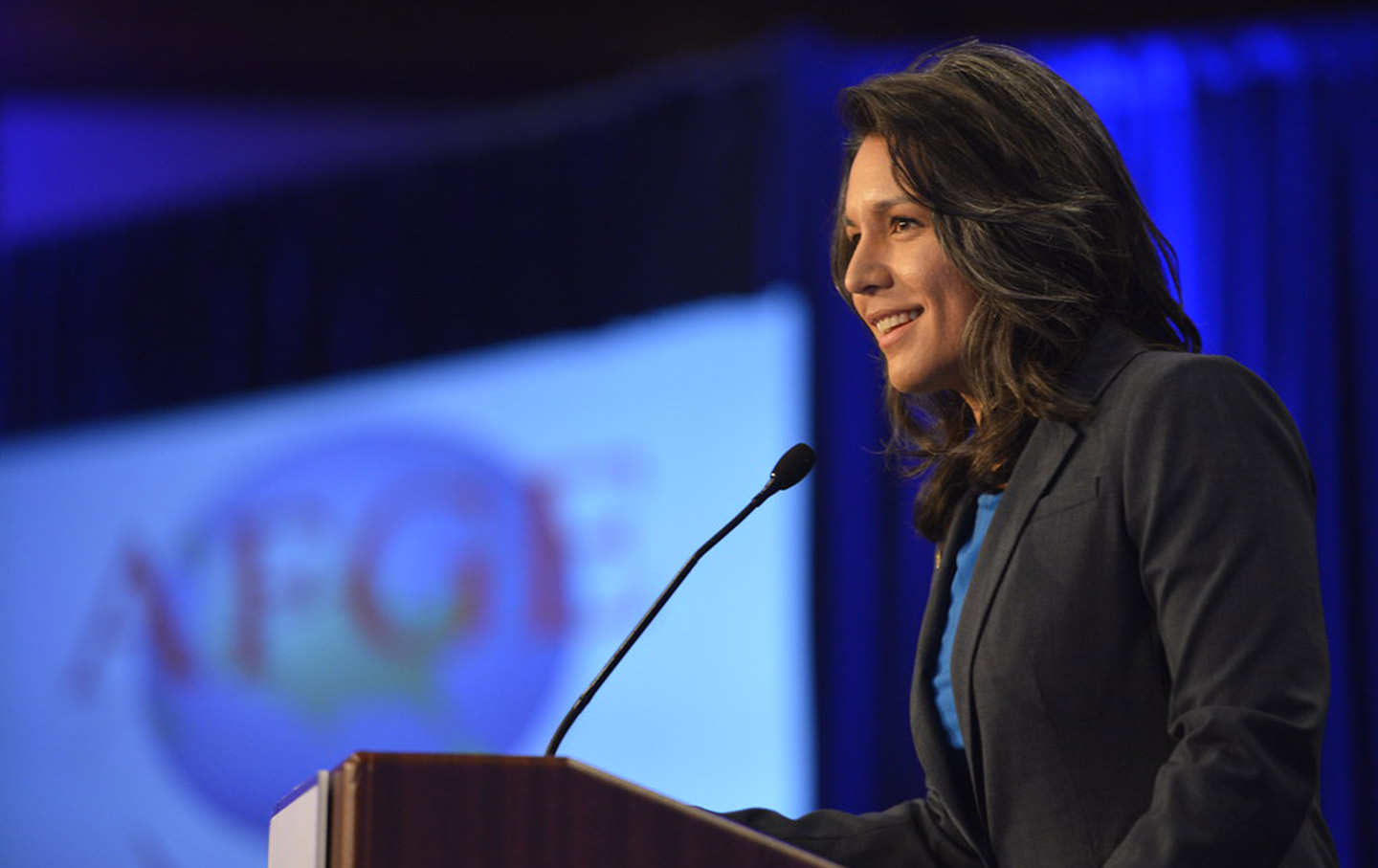
Google
Trends found that after the first Democratic presidential debate in Miami,
Tulsi Gabbard was the most searched candidate. Makes sense. The
congresswoman from Hawaii brought a bold critique of “regime-change wars,” nuclear
proliferation, and failed foreign policies to the debate stage. She made
statements that some characterized as controversial and that others thought necessary; she reflected
on her apology for socially conservative positions she once
embraced; and she engaged in one of the few actual debates in the debate: a
clash with Ohio Congressman Tim Ryan over continued US involvement in
Afghanistan that saw Gabbard win loud applause for her declaration that “we have to bring our troops home.”
She also delivered
one of the most effective takedowns of President Trump and his inner circle
heard during two nights of debating. “War
with Iran would be worse than war with Iraq,” the Iraq War veteran, who is
the first female combat veteran ever to seek the nomination for the presidency,
announced on Wednesday night. “Donald Trump and his chickenhawk cabinet—Mike
Pompeo, John Bolton, and others—are creating a situation where a spark would
light a war with Iran. Trump needs to get back into the Iran deal, swallow his
pride, and put America first.”
But
last week’s debate stages were so crowded that none of the candidates, many of
whom poll toward the back of a field that now includes more than two dozen
contenders, got very far in presenting a nuanced, let alone comprehensive,
worldview. Gabbard did more of that when she addressed the 87th Annual US Conference
of Mayors over the weekend.
In her speech to the
mayors who had gathered in Honolulu, the congresswoman made the case that “regime change wars” are costing
communities across the country too much—and that they must be understood as
local issues.
“That’s
why,” she explained, “it’s imperative that every mayor, every
leader at every level of government take action
to stand up and speak out about this danger of nuclear war that we’re facing,
speak out against these wasteful regime change wars and this new cold war
that’s sucking money out of our pockets and our communities.”
That’s an important
message that ought not be lost in the 2020 cacophony.
Cities
are dramatically impacted by foreign-policy choices, and by the federal budget
priorities that extend from them. They also have the potential to be serious players on the global stage.
It’s notable that Trump goes out of his way to attack London Mayor Sadiq Khan,
and that Khan has emerged as one of the most pointed critics of the American
president—writing recently that “Donald Trump is just one of
the most egregious examples of a growing global threat. The far right is on
the rise around the world, threatening our hard-won rights and
freedoms and the values that have defined our liberal, democratic societies for
more than seventy years.”
American
mayors have joined urban leaders
around the world to focus on the climate change issues that the Trump
administration neglects. And they have frequently spoken up about
international human rights abuses.
Two current mayors,
South Bend, Indiana’s Pete Buttigieg and New York City’s Bill de Blasio, joined
last week’s debates, as did a former mayor: Vermont Senator Bernie Sanders, who
led that state’s largest city for much of the 1980s. Gabbard is not the only
candidate who recognizes foreign policy as a local issue. But she is talking
about the issue in smart ways.
In
particular, she is focusing on the threat posed by nuclear weapons. The congresswoman noted Trump’s dismissive attitude toward agreements that seek to prevent nuclear
proliferation, while reminding the mayors of the preparations their cities must
make for missile alerts and other potential threats.
Recalling a false alert that caused panic in
Hawaii last year, Gabbard told the mayors, “We need a radical change in our foreign policy to prevent this
kind of thing from happening, and to make sure that our children and our
families and generations to come can live free from fear of a nuclear war.”
Take Action: Stop
using the treacherously influential word defense
regarding US foreign policy. Say and
write: The Department of War.
|
|
|
|
|
|
|
|
||||
The Progressive Magazine Urges Us to Examine Our Priorities in 5
articles. The Progressive June/July
2019.
Action. Ira Helfand. “Ban the Bomb–Before Our Luck
Runs Out.” We are closer to a nuclear war than we have ever
been. Seven ways it can happen. See at
end for complete article or go to https://progressive.org/magazine/ban-the-bomb-helfand/ Ira Helfand is past president of Physicians for
Social Responsibility and co-president of International Physicians for the
Prevention of Nuclear War (Nobel Peace Prize 1985).
Bill Lueders, (editor, The Progressive), “The Threats We
Face.,” same June-July
number. “In this issue of The Progressive, we look at existential
threats to life on Earth. . . .The threats are real, and growing.. . . .No one
understands the threat of nuclear war better than Ira Helfand.” See below.
Martin Fleck. “What a Nuclear War Would Mean.” Fleck discusses Blast, Burns, Radiation, and
Climate Disruption. Because a nuclear
war would kill millions of civilians,
155 UN countries in “Joint Statement on the Humanitarian Consequences of
Nuclear Weapons” (2014) called for “totally eliminating” nuclear weapons.
“The Day the World Almost Ended.”
Recounts 7 of the some dozen nuclear
catastrophe close calls.
“Blast from the Past.”
Some of the magazine’s past writing on the
dangers of nuclear war; for example, the cover story for the Oct. 1978 number
imagining the aftermath of a twenty-megaton nuclear explosion over Chicago.
ACTION: Add your name: no nuclear war, NO FIRST USE
|
Tue, Jun 4, 2019, 4:44 PM (3 days ago)
|
 |
||
|
|
||||
Dick — at any minute,
the President of the United States can start a nuclear war all by himself — a
war that could kill everyone on the planet.
There’s no such thing
as a small nuclear war. You, me, everyone we know and love, would be impacted.
It’s terrifying. But it doesn’t have to be this way.
One really simple
change, called the No First Use of nuclear weapons policy, can ensure no President — not Donald
Trump or whoever follows him — has the ability to start a nuclear war!
Right now, dozens of
candidates are running to be our next Commander-in-chief. We need to get them
on the record NOW committed to making this important policy shift the official
policy for the United States.
ACTION
Current U.S. nuclear
weapons policy is making the world more dangerous.
And that’s because the
U.S. is killing nuclear weapons treaties. The U.S. is spending gobs of money on
building new nuclear weapons — including a “gateway nuke” that makes a nuclear
war more likely. And the U.S. is destroying hard-earned diplomatic ties that
have helped keep the lid on the spread of nuclear weapons around the world.
That makes the
decisions of our next commander-in-chief even more consequential,
because they’ll have to pull us out of the threat of nuclear annihilation that
current U.S. policy is taking us dangerously close to.
We need to ensure NOW
that our next President — whoever they are — commits to NOT use nuclear weapons
first.
Thank you for working
for peace,
Erica, Tara, Mariam,
and the Win Without War team
© Win Without War Education Fund 2019
1 Thomas Circle NW, Suite 700, Washington, DC 20005
(202) 656-4999 | info@winwithoutwar.org
1 Thomas Circle NW, Suite 700, Washington, DC 20005
(202) 656-4999 | info@winwithoutwar.org
|
Action. Hold the LYNE on the new
"low-yield" Trident warhead!
|
|
||||||||||||||||||||||||||||||||||||||||||
|
|||||||||||||||||||||||||||||||||||||||||||
TMS PEACE JOURNALISM
Robert C. Koehler |
Common Wonders – TRANSCEND Media Service
2 May 2019 – The day
before he died, Martin Luther King said these words at a packed church in
Memphis: “Men for years now have been talking about war and peace. Now no
longer can they just talk about it. It is no longer a choice between violence
and nonviolence in this world, it is nonviolence or nonexistence. That is where
we are today. ”That’s where we are today . . . half a century later! Read more...
WAR AND WARMING
“Catastrophic climate change and nuclear war are unique in the
threat they pose to the very survival of human civilization.” Ira Helfand.
The Other
Unimaginable Threat: Climate Change. Increasingly,
commentators are seeing WAR AND WARMING as the most pressing threats demanding
our attention.
“The
other great existential threat we face today is climate change, the subject of
an entire recent issue” of The
Progressive. This June/July number
offers
Bill Lueders, “The Threats We Face” and “It’s a
Catastrophe.” Lueders’ conclusion: “These existential threats must be
addressed with equal urgency.”
Luders gives high praise to David
Wallace-Wells’ book The Uninhabitable
Earth and to Naomi Klein’s This
Changes Everything, and to
the Green New Deal and the video “Message from the Future with Alexandria
Ocasio-Cortez,” and he calls for massive
immediate civil disobedience to end fossil fuel subsidies. ACTION
Scott Russell, “The Battle Against Line
3.” The struggle against “expansion of a
pipeline to transport dirty tar sands oil.”
Alexandra Tempus, “’We’re Not Going Anywhere’:
An Interview with Winona LaDuke.”
Helfand’s article cited above.
Ban the Bomb–Before Our Luck Runs Out
We are closer to a nuclear
war than we have ever been.
We are closer to a nuclear war than we have ever
been.
That is the assessment of William Perry, who
served as Secretary of Defense under President Bill Clinton.

“The likelihood today of a nuclear catastrophe is greater than
during the Cold War,” Perry told an audience in Washington, D.C., early in the
Trump Administration. “Today, inexplicably to me, we are recreating the
geopolitical hostility of the Cold War and we are rebuilding the nuclear
dangers of the Cold War. We are doing this without any serious public
discussion, or any real understanding of the consequences of these actions: We
are sleepwalking into a new Cold War, and there is a very real danger we will
blunder into a nuclear war.”
Perry expounded on this theme recently in a Wall Street Journal
op-ed co-written with former U.S. Secretary of State George Shultz and former
U.S. Senator Sam Nunn, who chaired the Armed Services Committee. The trio warned that the world “may soon
be entrenched in a nuclear standoff more precarious, disorienting, and
economically costly than the Cold War.” They called for de-escalating tensions
caused by Trump’s “dysfunctional Russia policy” by building a framework for
strategic stability and announcing a joint declaration affirming the
senselessness of nuclear war.
This sense of heightened danger is shared by the experts who set the Bulletin of the Atomic Scientists’
Doomsday Clock at two minutes to midnight in January 2018 and reaffirmed that decision in January
of this year.
“Humanity now faces two simultaneous existential threats, either
of which would be cause for extreme concern and immediate attention,” the
group said. “These major threats—nuclear
weapons and climate change—were exacerbated this past year by the increased use
of information warfare to undermine democracy around the world, amplifying risk
from these and other threats and putting the future of civilization in
extraordinary danger.”
Among the factors driving concern upward were President Trump’s
decision to unilaterally abandon the Iran nuclear deal
and withdraw from the
Intermediate-Range Nuclear Forces Treaty while joining other nuclear-armed
countries in sweeping programs of “nuclear
modernization.”
Yet despite these alarming developments, the imminent threat of
nuclear war barely registers on most people’s radar. In the early 1980s, the
danger of nuclear war emerged as a matter of widespread public concern,
with one survey finding that 76 percent of Americans believed nuclear war was
“likely” within a few years. Millions of people took political action to stop
the Cold War arms race, including a rally in New York City on June 12, 1982,
that drew one million people, then
the largest political demonstration in U.S. history.
But with the end of the Cold War, people began to think and act as
though the danger posed by nuclear weapons had passed.
Of course, the danger never went away. Thousands of nuclear
warheads remained, along with the possibility that they would be used, perhaps
even by accident. In January 1995, the United States launched a weather rocket from
Norway that caused a false alarm in Moscow. We came within minutes of a full
scale nuclear war—four years after the collapse of the Soviet Union and the end
of the Cold War.
Today, at latest count, the nine nuclear nations maintain an arsenal of 14,500
nuclear weapons. The danger of them being used has increased dramatically in
recent years (see sidebar). There is an urgent need to rebuild the broad public
understanding of this danger to bring about fundamental change in nuclear
policy and end that danger once and for all.
We have been incredibly fortunate throughout the nuclear weapons
era. As Robert McNamara famously declared after the Cuban Missile Crisis, “We lucked
out. It was luck that prevented nuclear war.” The policies of the nuclear
weapons states are essentially a hope that this luck will continue. But hoping
for good luck is not an acceptable security policy and, sooner or later, our
luck will run out.
To erase the threat of unparalleled catastrophe that has existed
since the dawn of the nuclear age, we must articulate a clear strategy to
eliminate these weapons before they eliminate us.
Internationally, 122 nations voted in July 2017 to adopt the
Treaty on the Prohibition of Nuclear Weapons, which bans the use and possession
of nuclear weapons as well as activities that make it possible to build and
maintain them. The ratification process is moving forward; when fifty nations
formally ratify the treaty it will enter into force, creating a powerful new
standard where it is the countries with nuclear weapons who are the ultimate
“rogue states.”
Here in the United States, a grassroots campaign called Back from the Brinkseeks to embrace the goals of
the treaty with a “Green New Deal” for the nuclear threat, a comprehensive
prescription for how to avoid nuclear war. It calls on the United States to
recognize that nuclear weapons, far from being agents of our security, are in
fact the greatest threat to our safety and must be eliminated as the only way
to assure that they will not be used.
Representatives Jim McGovern, Democrat of Massachusetts, and Earl
Blumenauer, Democrat of Oregon, have drafted a resolution, H.R. 302, to adopt this new policy
prescription.
The core of the campaign is a five-point platform of policies that the
United States should pursue. The central plank is to commence negotiations with
the other eight nuclear weapons states for an enforceable, verifiable,
timebound agreement to dismantle nuclear arsenals. There is no guarantee such
an initiative will be successful, but there is no reason to assume that it will
not be: It has never been tried.
While various U.S. Presidents, including Ronald Reagan, Jimmy Carter, and Barack Obama, have given lip service to the
idea that the United States will seek the security of a world free of nuclear
weapons, none has actively pursued this goal. That is the fundamental change
that must take place and to which we must commit.
The other four planks in the Back from the Brink platform are
common-sense steps that can be taken to lessen the danger of nuclear war as
these negotiations proceed and the weapons are being dismantled. They are:
1) The United States should adopt a No First Use policy, making it
clear that it will not initiate nuclear war. This will reduce tensions during
future crises, decrease the possibility of miscalculation by future
adversaries, and signal the United States’ disinclination to destroy the world.
Legislation to implement this policy has been introduced in both
houses of Congress, the House bill (H.R 921) by Representative Adam Smith,
Democrat of Washington, and the Senate bill (S.272) by Senator Elizabeth Warren,
Democrat of Massachusetts.
2) We should end the sole unchecked authority of any President to
launch a nuclear attack. The Constitution provides unequivocally that only
Congress can declare war, but current practice allows the President to
initiate a nuclear attack—surely an act of war—without Congressional authorization
and without the approval of the Cabinet, the Vice President, or anyone else.
This policy evolved during the Cold War, when it was felt the
President needed to be able to respond quickly to an attack from the Soviet
Union that might destroy America’s land-based nuclear missiles. The current
sea-based Trident missiles are not vulnerable in this way and there is no need
to delegate this terrible power to any one individual. Legislation to limit
presidential authority has been introduced in the House (H.R. 669) by Representative Ted Lieu,
Democrat of California, and in the Senate (S. 200) by Senator Edward Markey,
Democrat of Massachusetts.
3) The U.S. nuclear arsenal should be taken off hair-trigger
alert. Hundreds of warheads in both the United States and Russia are mounted on
missiles that can be launched in fifteen minutes. This makes them vulnerable to
cyber attack, accidents, and impulsive or unauthorized decisions. The policy of
maintaining weapons in this high-alert state is a vestige of the Cold War and
should be abandoned. If the United States decides at some point that it needs
to destroy the world, it can wait twenty-four hours to do it.
4) The United States should cancel the plan to replace its entire
nuclear arsenal with enhanced weapons. The current plan calls for spending some $1.7
trillion, after inflation, over the next thirty years
replacing and enhancing every component of its nuclear arsenal in a program
that will assure the existence of nuclear weapons for decades to come (or until
they are used). This plan, mirrored by similar efforts in the other nuclear-armed
states, will fuel a new and destabilizing arms race. Several bills in Congress
seek to curtail this dangerous and unnecessary spending spree including H.R. 1086, S. 401, H.R. 1231, S. 312, H.R. 1249.
The Back from the Brink campaign has been joined by many civic organizations, faith
communities, and professional associations and has won the support of a rapidly
growing list of cities, towns, and states. It was endorsed by unanimous votes
of the U.S. Conference of Mayors, and the Baltimore, Los Angeles, and Washington, D.C., city councils and by an overwhelming vote of the California state
legislature. It is currently before the state legislatures in
Maine, Massachusetts, New Jersey, Oregon, Washington, and Vermont as well as
many town and city councils.
Yet, obviously, despite this broad grassroots support,
negotiations for the elimination of nuclear weapons will require a paradigm
shift in the thinking of the leaders of nuclear-armed states, and aggressive
leadership by at least one of the nuclear powers. They must be persuaded by the
force of world opinion that nuclear weapons are not necessary for their safety.
In the early 1980s, few expected that the United States and the
Soviet Union could overcome their enormous mutual distrust and end the arms
race. When Mikhail Gorbachev proposed a halt to all nuclear
weapons tests in 1986, the United States initially rebuffed the overture. But
he persisted, and over time both he and Ronald Reagan were able to understand
that nuclear weapons posed a greater threat to both of their countries than either
did to each other.
There is not an obvious successor to Gorbachev among today’s world
leaders. But a large group of U.S. politicians are vying for the presidency in
2020 and perhaps one of them will have the wisdom and courage to follow in his
footsteps. The United States cannot afford to elect a good President in 2020;
it must elect a great President. And the definition of greatness at this time
includes the ability to successfully address the threats we face, from nuclear
weapons and climate change. The next President must make these top priorities.
Back from the Brink seeks to enlist ordinary citizens in a
national campaign that will create the political space and political pressure
that will allow the next President to be successful. Like the Nuclear Weapons
Freeze Campaign of the 1980s, it seeks to create a national consensus of what
nuclear policy ought to be in the hope and belief that such a consensus will
lead to fundamental policy change.
It is not enough to work on incremental changes to our nuclear
policy. Such changes are valuable, but will not do what must be done. They must
be part of an explicit and clearly articulated plan to actually achieve the
security of a world free of nuclear weapons, and we must pursue that overall
plan now. Time is not on our side.
Sidebar: Seven Possible Pathways to Nuclear
War
1. United States and Russia: These two countries
together possess more than 90 percent of
the world’s nuclear weapons and, despite President Trump’s fondness for
Vladimir Putin, relations between them are at the lowest point in thirty years, since the
end of the Cold War. Events in Syria and Ukraine and tensions in the Baltics make clear
the possibility of conflict. Trump’s recent decision to withdraw from the
Intermediate-Range Nuclear Forces Treaty underlines the potentially nuclear
nature of a future war.
2. United States and China: The economic rivalry
between the world’s two largest economic powers has become increasingly hostile and there is now an active
military dimension to that rivalry. Chinese and U.S. naval forces
routinely play chicken in the South China Sea, a
disastrous incident waiting to happen.
3. United States and North Korea: In early 2018, the United
States and North Korea appeared to be headed toward a nuclear confrontation.
The “on again, off again” bromance between Donald Trump and Kim Jong-un brought
a temporary reprieve, but the collapse of the Hanoi Summit revealed how dangerous
the situation remains.
4. South Asia: Perhaps the most dangerous potential conflict is one that
receives scarce attention in the West. India and Pakistan have fought four
wars; there is almost daily low-level fighting on their disputed border in
Kashmir; and the military doctrines of both countries create a high level of concern that
a future war between them will go nuclear. Use of less than half of the 290
weapons in their combined nuclear arsenal would cause worldwide climate disruption
and a global famine putting two billion people at risk.
5. Climate change: The nuclear powers periodically claim they are willing to
get rid of their nuclear weapons—just not yet. They say conditions are not ripe
today but, in the future, when the world is safer, they will seek to disarm.
Unfortunately, the world is not getting safer. Climate change is placingincreasing stress on societies
around the world and, as it progresses, there will be increased conflict and
mass migration on a scale unprecedented in history. If nuclear weapons remain
on the table, the danger that they will be used will also increase.
6. Cyber terrorism: We used to worry that terrorists might build or steal a
nuclear weapon and blow up a city like New York or Moscow, and that is still a
danger. But the greater danger is that terrorists will
carry out a cyber attack that induces one of the nuclear-armed states to launch
its nuclear weapons in the mistaken belief that it is under attack.
7. The Trump Factor: Apart from his many wrongheaded policies, Donald Trump’s
personal instability increases the danger of nuclear war. This is not a
partisan comment; concern about his control over a nuclear arsenal is shared by
members of his own party. During the 2016 campaign, fifty prominent Republican
security experts warned that Trump “lacks the
character, values, and experience” to command a nuclear arsenal. For years, the
United States has maintained that it would be intolerable for even a single
nuclear weapon to fall into the wrong hands, including a rogue state or a terrorist
group. In January 2017, we turned 6,800 nuclear weapons over to Donald Trump.
2018 NEWSLETTER CONTENTS
Back from the Brink: Hiroshima-Nagasaki Remembrance Program
and Nuclear Weapons Abolition, August
12, 2018
The Program, 6pm
ABOLITION MOVEMENT
Petition your Congressmen
Ellsberg’s new book, The Doomsday Machine
US Anti-Nuclear Organizations:
ICAN, NAPF, FAS, GZ, BAS, WAND, Peace Action
VFP, Demonstrate v. Tridents on East Coast
WAND
Peace Action
Danger at Kashmir: Nuclear India v. Nuclear Pakistan
ABOLITION MOVEMENT
Petition your Congressmen
Ellsberg’s new book, The Doomsday Machine
US Anti-Nuclear Organizations:
ICAN, NAPF, FAS, GZ, BAS, WAND, Peace Action
VFP, Demonstrate v. Tridents on East Coast
WAND
Peace Action
Danger at Kashmir: Nuclear India v. Nuclear Pakistan
END HIROSHIMA NAGASAKI OMNI REMEMBRANCE/BAN
THE BOMB ACTION 2019


